Cybersecurity is no longer simply an information technology issue. For Indiana Title Producers, it has become a fundamental part of protecting clients, escrow funds, confidential information, and the integrity of real estate transactions.
Every day, title professionals handle valuable information that cybercriminals want: bank account information, wire instructions, closing documents, Personally Identifiable Information (PII), Nonpublic Personal Information (NPI), loan information, email communications, and large financial transactions.
That makes the title industry an attractive target.
Cybercriminals Are Targeting Real Estate Transactions
The numbers demonstrate the seriousness of the threat.
According to a 2025 American Land Title Association (ALTA) cybercrime study, more than 40% of title companies reported receiving at least one email per month attempting to change wiring or payoff instructions. The same study found that 7% of companies reported actually wiring funds to a fraudulent account, while 13% reported that their customers had wired funds to a fraudulent account.
The FBI’s Internet Crime Complaint Center reported approximately $2.77 billion in Business Email Compromise losses during 2024 across all reported sectors. Real-estate-related complaints accounted for approximately $173.6 million in reported losses that year.
These aren’t theoretical risks. They represent real businesses, real transactions, and real money.
Is the Title Industry Doing Enough?
The good news is that many title companies are taking cybersecurity seriously. However, there are still opportunities for improvement.
ALTA’s 2025 study found that 78% of responding companies trained employees at least annually on identifying and preventing wire fraud attempts. However, only 26% reported using simulated phishing email testing of employees. The study also found that 51% provided consumer training and 37% provided training to real estate agents.
That matters because cybersecurity training should not be viewed as something employees complete once and forget.
Cybercriminals continuously change their tactics.
An employee who recognizes yesterday’s phishing email may not necessarily recognize tomorrow’s more sophisticated attack.
Why Are Title Producers Attractive Targets?
Consider what passes through a typical real estate transaction:
- Names and addresses
- Social Security numbers and other identifying information
- Bank account information
- Loan documents
- Closing documents
- Escrow information
- Email communications
- Wire transfer instructions
- Large amounts of money
A cybercriminal doesn’t necessarily need to hack an entire title company’s network.
Sometimes all the criminal needs is one compromised email account, one stolen password, or one employee who clicks the wrong link.
Business Email Compromise Is Especially Dangerous
Business Email Compromise, commonly called BEC, is particularly dangerous to the title industry because the fraudulent communication can appear legitimate.
A criminal may gain access to an email account belonging to a buyer, seller, real estate agent, attorney, lender, or title professional. The criminal can then monitor communications and wait for the appropriate moment to introduce fraudulent payment instructions.
The FBI specifically warns that BEC schemes target participants throughout real estate transactions, including buyers, sellers, attorneys, title companies, and real estate agents.
The email may look familiar.
The property address may be correct.
The closing date may be correct.
Even the names of the people involved may be correct.
But the bank account belongs to the criminal.
That’s why knowledge and verification procedures are so important.
Cybersecurity Education Creates Another Layer of Defense
Firewalls, antivirus programs, encryption, and other security technologies are important, but technology cannot eliminate every risk.
Employees remain an essential part of an organization’s cybersecurity defenses.
A trained title professional is more likely to stop and question:
“Why did these wire instructions suddenly change?”
“Why is this lender asking me for my password?”
“Why doesn’t this email address look quite right?”
“Why am I being pressured to act immediately?”
“Should I verify this request before proceeding?”
Those few seconds of hesitation and verification could prevent a significant financial loss.
Introducing Cybersecurity for the Title Professional
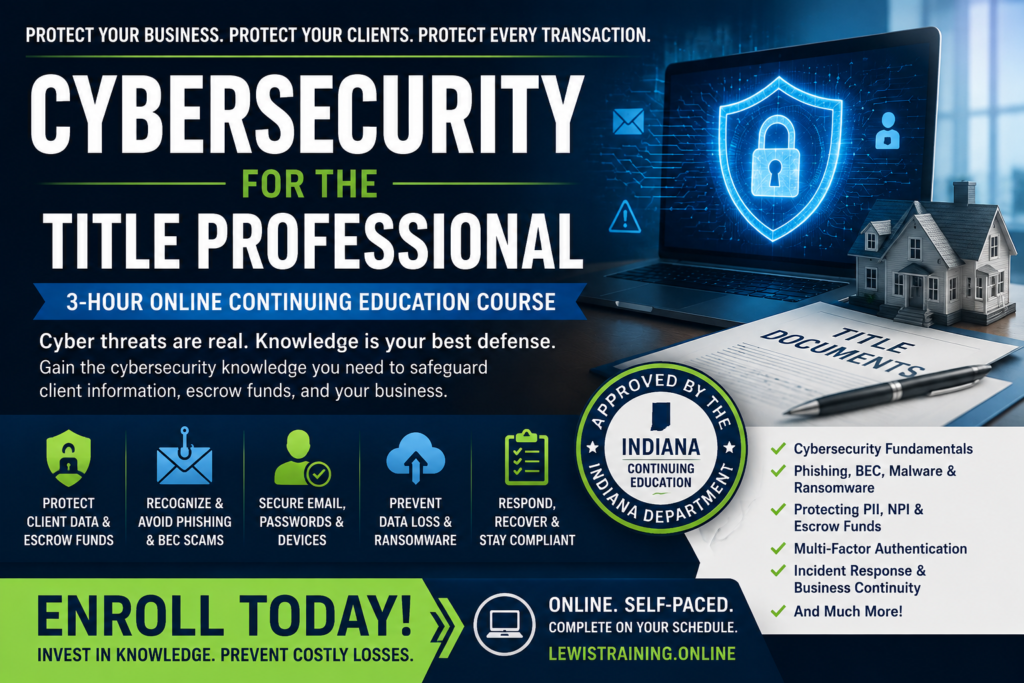
Lewis Training Services developed Cybersecurity for the Title Professional, a 3-hour online Continuing Education course approved by the Indiana Department of Insurance, to help Indiana Title Producers better understand the cybersecurity risks affecting today’s title and real estate industries.
Participants learn about:
- Cybersecurity fundamentals
- Phishing and spear phishing
- Business Email Compromise
- Malware and ransomware
- Credential theft
- Social engineering
- Protecting PII and NPI
- Multi-Factor Authentication
- Password security
- Encryption
- Secure document management
- Remote work security
- Vendor and third-party security
- Incident response
- Business continuity
- Disaster recovery
- Data backups
- Cyber insurance
- Creating a cybersecurity culture
Don’t Just Complete Your CE—Use It to Become Better Prepared
Continuing Education should be more than checking a box to maintain a license.
It should provide knowledge that helps you become a better professional.
For Indiana Title Producers, cybersecurity education provides an opportunity to accomplish both.
You can earn 3 hours of Indiana Continuing Education credit while learning practical strategies that can help protect your clients, your organization, your transactions, and your professional reputation.
Cybercriminals are continuing to improve their methods.
Title professionals must continue improving their knowledge.
Stay informed. Stay alert. Stay secure.
Enroll in Cybersecurity for the Title Professional through Lewis Training Services at LewisTraining.online.
Lewis Training Services — Education Designed for Today’s Title Professional.